Using AI for Your Accounting: A Practical Guide for UAE Businesses

BLOGS
October 01, 2026
We get it. You’ve typed a question into ChatGPT or Claude and got back an answer that sounded confident, detailed, and most importantly, instant. No waiting for an accountant to respond. No invoice at the end of it.
We’re not here to tell you to stop. AI tools are genuinely useful, and pretending otherwise would be dishonest. But there are things they do well, things they do badly, and a few things they can get catastrophically wrong when it comes to your UAE business finances. This is a practical guide to navigating all three.
What AI Tools Are Actually Good At
Used correctly, AI can save you real time. It’s excellent for explaining concepts, what is IFRS 15, how does the reverse charge mechanism work, what’s the difference between exempt and zero-rated supplies. It’s good at drafting templates, structuring spreadsheets, and helping you think through a problem before you bring it to your accountant.
Think of it as a very well-read research assistant. It has absorbed an enormous amount of accounting and tax literature. It can explain things clearly. It can point you in the right direction.
What it cannot do is apply that knowledge accurately to your specific business, your specific numbers, and your specific regulatory environment, particularly in the UAE, which is one of the fastest-moving tax jurisdictions in the world right now.
Where It Goes Wrong and Why It Matters
Here is the most important thing to understand about AI and UAE accounting: the models are trained on data with a cutoff date. The UAE introduced Corporate Tax in 2023. FTA Decision No. 13 on supplier verification took effect this week. IFRS 18 replaces IAS 1 in January 2027. The e-invoicing framework has changed multiple times this year alone.
An AI model may not know any of this. Or it may know some of it partially, and give you an answer that was correct six months ago and is wrong today.
It won’t tell you it’s uncertain. It will sound just as confident whether it’s right or wrong.
We’ve seen businesses make VAT recovery decisions, structure intercompany transactions, and interpret Corporate Tax obligations based on AI output that was plausible, well-written, and incorrect.
The Practical Rules We’d Suggest
Treat every AI output as a starting point, not a conclusion. If an AI tool tells you that something is VAT-exempt, or that a particular expense is deductible, that’s a hypothesis to verify, not an answer to act on. Cross-reference with FTA guidance, IFRS standards, or your accountant before making a decision.
Be especially cautious with numbers. AI tools can make arithmetic errors. They can misapply formulas. They can produce a beautifully formatted spreadsheet where the logic underneath is wrong. Always check the workings, not just the output.
Never paste sensitive financial data into a public AI tool. Your customers/suppliers names, bank account details, payroll figures, and commercial terms have no business in a public AI interface. Most AI tools are clear in their terms of service about how data is handled, but the safest position is simply not to put confidential information in.
Ask it to show its reasoning. If you ask an AI tool how it arrived at an answer, you’ll often spot where it’s made an assumption that doesn’t apply to your situation. This is one of the most useful habits you can develop when using these tools.
Know what you don’t know. The danger isn’t the question you ask AI. It’s the question you don’t know to ask. A good accountant brings pattern recognition built from hundreds of real situations. AI brings breadth without that depth of applied judgment.
Our View at Nishe
We believe in using technology, including AI, where it genuinely helps. We use it ourselves. But accounting is one of those fields where the cost of a confident wrong answer can be significant: a missed filing deadline, an incorrect VAT position, a CT return that doesn’t reflect the actual position of the business.
The UAE regulatory environment is moving faster than any AI model can keep up.
That’s not a reason to avoid these tools. It’s a reason to use them carefully, verify what they tell you, and know when the stakes are high enough to pick up the phone.
We’re always happy to be that phone call.
Get in touch with the Nishe team
Get Connected

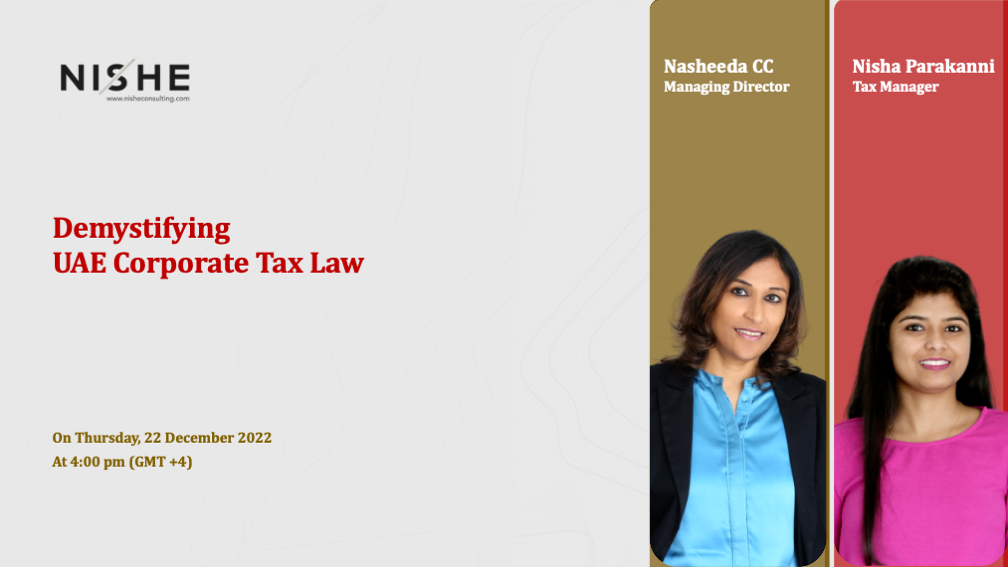
Demystifying UAE Corporate Tax
The Ministry of Finance (MoF), UAE recently issued Federal Decree-Law No. 47 of 2022 on the Taxation of Corporations and Businesses.
Are you wondering what it means for you practically?
Click on the link to watch the webinar where we attempt to demystify some of the most essential provisions of the UAE Corporate Tax Law.